Managing sports courts and recreational facilities can be challenging, especially when dealing with bookings, memberships, payments, and customer communication. As sports facilities continue to grow in popularity, manual management methods are becoming less effective and more time-consuming. Facility owners need a reliable way to streamline daily operations while providing a better experience for players and members.
Court management software is designed to solve these challenges by automating key administrative tasks. It helps sports facilities manage reservations, schedules, payments, memberships, and customer interactions from a single platform. By reducing manual work and improving organization, this software allows facility owners to focus more on delivering quality services and growing their businesses.
What Is Court Management Software?
It is a digital solution that helps sports facilities manage and organize court-related operations. It is commonly used by multi-sport complexes. The software provides a centralized system where owners, staff, and players can access important information and perform various tasks.
Instead of relying on spreadsheets, paper schedules, or manual booking systems, facilities can use court management software to automate reservations and administrative processes. The software keeps track of court availability, manages member accounts, processes payments, and generates reports. This improves efficiency while reducing the risk of scheduling conflicts and human errors.
Why Do Sports Facilities Need It?
Sports facilities often handle multiple courts, numerous bookings, memberships, and customer inquiries every day. Managing these activities manually can quickly become overwhelming and may lead to mistakes that affect customer satisfaction.
This software simplifies operations by providing a structured and automated system. It ensures that court schedules remain accurate, bookings are processed instantly, and payments are recorded properly. Facilities can also improve communication with members by sending automated reminders, updates, and notifications. As a result, sports centers can operate more smoothly while delivering a better overall experience for their customers.
How Court Management Software Works?
1. Court Scheduling
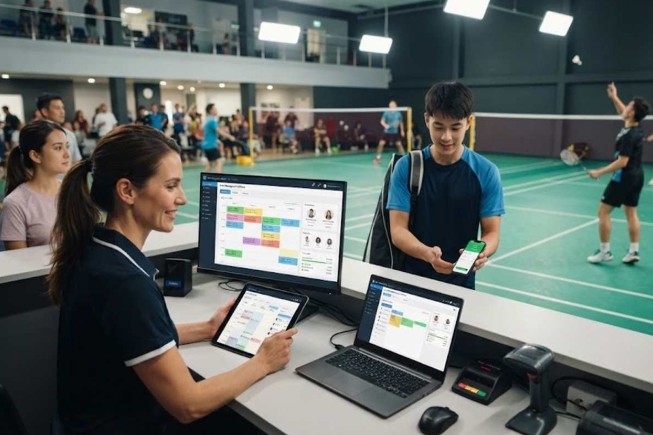
The software maintains a real-time schedule of all available courts. Staff and players can view availability instantly and reserve courts based on open time slots. This eliminates double bookings and scheduling confusion.
2. Online Booking
Players can access the booking platform through a website or mobile application. They can choose a court, select a preferred date and time, and confirm their reservation within a few clicks. With badminton booking software, court availability is updated automatically after every reservation, helping prevent scheduling conflicts and ensuring a smooth booking experience for players.
3. Payment Processing
Many court management platforms include integrated payment systems. Players can pay online using credit cards, digital wallets, or other payment methods. The software records transactions and generates receipts automatically.
4. Data Management
The system stores customer profiles, membership details, booking history, and payment records in a centralized database. Facility managers can access this information whenever needed and use it to improve services and decision-making.
Key Features of Court Management Software
1. Booking Management
One of the most important features is court booking management. It allows facilities to manage reservations efficiently, monitor court usage, and prevent scheduling conflicts through automated updates.
2. Membership Management
The software keeps track of member information, subscriptions, renewals, and membership plans. It helps facilities maintain accurate records while simplifying membership administration.
3. Automated Notifications
Automated notifications help keep players informed about bookings, cancellations, schedule changes, and upcoming events. These reminders reduce no-shows and improve communication.
4. Payment and Billing
Integrated billing systems make it easy to collect payments, issue invoices, and track financial transactions. This reduces administrative workload and improves financial accuracy.
5. Reporting and Analytics
Advanced reporting tools provide valuable insights into facility performance. Managers can analyze booking trends, revenue, membership growth, and court utilization to make informed business decisions.
Benefits for Facility Owners
Court management software provides numerous advantages for sports facility owners. It helps streamline operations while improving customer service and overall profitability.
Benefits for Facility Owners:
- Reduces manual administrative work.
- Minimizes scheduling errors and double bookings.
- Improves court utilization rates.
- Automates payment collection and billing.
- Enhances communication with members.
- Provides detailed business reports and analytics.
- Saves time for staff and management.
- Increases operational efficiency.
- Supports business growth and scalability.
- Improves customer satisfaction and retention.
By automating routine tasks, facility owners can focus more on expanding services, organizing events, and increasing revenue opportunities.
Benefits for Players and Members
Players and members also benefit significantly from management software. The convenience and accessibility offered by digital booking systems create a better overall user experience.
Benefits for Players and Members:
- Easy online court reservations.
- Instant access to court availability.
- Secure online payment options.
- Automated booking confirmations.
- Convenient mobile access.
- Faster check-in processes.
- Reduced risk of booking conflicts.
- Easy membership management.
- Timely reminders and notifications.
- Improved overall customer experience.
These benefits make it easier for players to enjoy their favorite sports without dealing with unnecessary scheduling difficulties or administrative delays.
The Future of Court Management Software
The future of court management software looks promising as technology continues to evolve. Artificial intelligence, machine learning, and advanced analytics are expected to play a larger role in facility management. These technologies can help predict booking trends, optimize scheduling, and improve customer engagement.
Mobile applications will continue to become more sophisticated, allowing users to manage bookings, memberships, and payments directly from their smartphones. Cloud-based solutions will also become increasingly popular because they offer greater flexibility, security, and accessibility. As sports facilities seek more efficient ways to operate, it will remain an essential tool for modern facility management.
Choosing the Right Management Software
Nesbook is a modern court management solution designed to help sports facilities manage bookings and daily operations more efficiently. It provides an organized platform that simplifies administrative tasks and improves overall workflow.
With Nesbook, facility owners can handle court reservations, schedules, payments, and customer information from a single system. Its user-friendly interface makes it easy for both staff and players to manage bookings and access important information.
The platform is built to support growing sports businesses by improving efficiency and enhancing customer experiences. By automating routine tasks and reducing manual work, it helps facilities save time and focus on delivering better services.
Conclusion
Court management software has become an essential solution for sports facilities seeking to improve efficiency, organization, and customer satisfaction. By automating bookings, payments, memberships, and communication, it simplifies day-to-day operations and reduces administrative burdens.
As technology continues to advance, these systems will become even more powerful and user-friendly. Whether managing a small local sports club or a large multi-court facility, investing in the right software can help streamline operations, increase revenue, and deliver a better experience for both facility owners and players.